Showing posts with label accounting period. Show all posts

Sunday, April 19, 2009

Accrual Basis of Accounting

One method which is available to accountants for keeping record of business transactions is called the Accrual Basis of Accounting. Accrual method of record-keeping means that the items are recorded in the books of accounts based on the Matching Principle.

Matching Principle means that an item which relates to the Year 2000, is recorded in the books of accounts related to that period. For example, if during the Year 2000 the company pays insurance premium for the coming year then although it will be recorded in the books but not exactly as an expense. Rather it is a prepaid expense, which relates to the coming year.

Hence, Accrual method means that any income which has been earned but which has perhaps not been collected, is recorded as an earning.


In the above shown entry of sales, the income comprises of two parts i.e. the cash part and the one which is based on credit. This part is still collectible and the company's books will continue to show Debtors worth 500 against this income.
But because the books are being maintained on Accrual basis, so the entire sales of 1,500 is recorded. In an alternative method of record-keeping the treatment will differ. That method is known as the Cash Based System of Accounting.

Posting Into Ledgers

After the basic recording of daily business transactions takes place, this information needs to be summarized in order for it to be of any material use for the users of such information. These users mainly include the management of the business itself, so that it can evaluate the overall performance of the company's operations during a particular period. Other users include potential investors, the current shareholders, taxation authorities and other regulatory bodies.

All the journalized transactions are put under various distinct heads. For instance, if electricity expense is being incurred then it will be put under the head Electricity. And each electricity bill which is paid during the period will fall under this head.

The same is done for each and every head of the business. At the end of period these heads are balanced to determine, the credit or debit balance of the head.
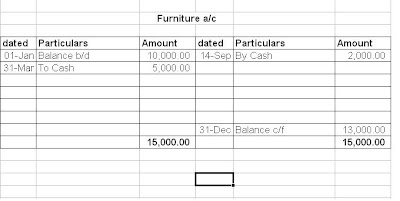
Below the Furniture account is shown for the year with basic entries during the year, and finally the account is totalled to determine the balance.


From this example of the Furniture account, the simple concept of posting entries related to Furniture into its respective ledger can be understood. The first item shown is the balance of Furniture which was available at the beginning of the period Jan-1. Then on 31-Mar new furniture was purchased for cash. This is shown on the right side of the ledger which represents the debit side. We know from past experience that an increase in an asset is debited.
Then, some of the furniture was sold for cash on 14-Sep. This will be represented on the credit side of the account as the asset is decreasing or going out of the business. At the close of the period, the account is totalled. This is done by adding all items on the heavier side of the ledger which in this case is the Debit side. After this total is achieved the items on the other side are simply subtracted from it. This closing balance is the figure which will be shown on the balance sheet.

Wednesday, March 18, 2009

FOH Applied Rate and Cost Drivers

One of the tools used for controlling FOH costs is the use of an FOH applied rate. Now how do we calculate this applied rate and what is its purpose? I'll start with the purpose. This is a budgeted rate based on the expected working conditions of the company, which is used to budget for the coming period.

The formula of FOH rate is = Total Budgeted Indirect Expenses/Expected capacity
The expected capacity could be expected hours of labour for the company's budgeted target of production, hours of machine running for the production of units expected, etc. Whatever it may be it is up to the management but it is better that the denominator chosen be the cost driver of that product.
Cost Driver is any activity in the production process that is primarily and largely responsible for the costs incurred. The higher the quality of the cost driver chosen the better the calculated applied rate.

Rules for Journalizing Transactions

The basic operation of financial accounting within an organization starts from the journalizing of day-to-day transactions. Any business transaction no matter how inconsequential it may seem has to be properly recorded in the Journal.

As, I mentioned in the previous posts regarding classfication of elements, after having identified the respective class of the item, we only have to follow some basic rules. These rules are mentioned hereunder:

For Assets the rule is that if the asset is flowing towards the company (whose accounts we are maintaining), then the Asset account will be debited. And if the asset is disposed off in any way then the Asset account will be credited. These rules are the absolute rules of thumb for accounting. So, remember them always!

As I referred to previously Liability is treated oppositely to Assets. An increase in a Liability i.e. the company's payable increases, then the Liability account will be credited. And in case the liability is reduced by payment then the Liability account will be debited.

Likewise, the incurring of any expense will be debited and the earning of any revenue or income will be credited.

Capital is not absolutely but technically treated as a Liability which the company owes to the Owner of the business. So, the treatment is same as that for liabilities. When capital is introduced into the business then this increase is credited to the Owner's capital because this transaction results in the company owing more to the Owner. And debited when the Owner withdraws something out of the company for personal use.

Sunday, March 15, 2009

The Fundamental Concept

Whenever, we would wish to account for any item in the subject of accounting the first step is to identify the nature of the element. Is the item an asset, liability, income, expense, or capital. The treatment of the item depends on this identification.

However, for beginners I think we better distinguish between the above mentioned items.

  • ASSETS are expenditures which are incurred by an entity which benefit the organization for more than one accounting period. Such items are called Capital expenditures because the benefit exceeds the normal accounting period being followed by the company. Such expenditures are non-recurring in nature i.e. these are relatively rare. For example, if a company purchases a truck for usage in business, then this transaction will be a capital expenditure and the item should be classified as an asset. Why? The benefits from the truck are expected to flow to the entity over a long period of time, which would definitely exceed the normal accounting period. Such items are BALANCE SHEET ITEMS.

  • The mirror image of an asset is a LIABILITY. Liability is an obligation of the company which might have accrued against any expenditure. For example, when a certain transaction takes place like the purchasing of the truck mentioned above, it should be against the payment of its sales price. But businesses don't run on cash payments all the time. Suppliers allow their customers to purchase items on credit i.e. the payment is made at a later time. Any item which results in a future obligation like this is classified as a liability which is also a BALANCE SHEET ITEM.

  • EXPENSES, on the other hand are expenditures just like asset are, but these are mostly recurring in nature and the benefits of these are not expected to flow to the entity beyond the normal accounting period. Such items are INCOME STATEMENT ITEMS.

  • INCOME as the name suggests is revenue generated by the entity's normal trading operations. There might not necessarily be an inflow of cash, because remember we also allow credit to certain customers of ours. The revenue generated is the primary source of survival of the company. This is also an INCOME STATEMENT ITEM.

  • Finally, CAPITAL refers to the investment made or drawings by the owner of the business. This is the intial source of funds which the owner used to get the business up and running. Later on the person may invest more depending on the requirements of the business. In addition to it, he may withdraw part of his investment.